

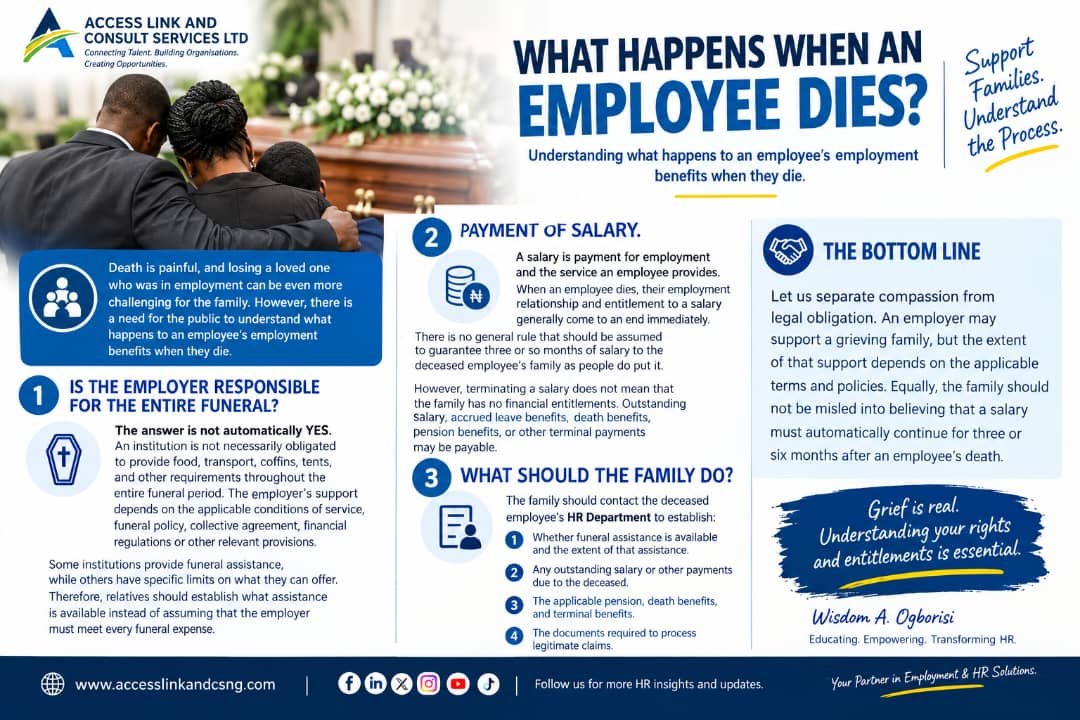
WHAT HAPPENS WHEN AN EMPLOYEE DIES? Understanding Funeral Assistance, Salary, Pension and Employment Benefits
By Wisdom A. Ogborisi
Educating. Empowering. Transforming HR.
Death is painful, and losing a loved one who was in employment can create emotional, practical and financial challenges for the family. During such a difficult period, relatives may have important questions about funeral assistance, outstanding salary, pension rights, death benefits and other payments connected with the deceased person’s employment.
Understanding the difference between an employer’s compassionate support and a legal or contractual obligation can help families make informed decisions and avoid relying on assumptions.
The exact position depends on applicable laws, the employee’s contract and conditions of service, workplace policies, pension arrangements and any collective agreement. Let us examine the key issues.
- Is the employer responsible for the entire funeral?
The answer is not automatically yes.
An employer is not necessarily required to pay every funeral-related expense, such as food, transportation, a coffin, tents, venue costs or other arrangements throughout the funeral period.
The employer’s responsibility depends on applicable employment terms, funeral assistance policies, collective agreements, financial regulations and relevant law.
Some organisations have a defined funeral assistance or death-in-service policy. They may provide a fixed grant, contribute a specified amount, offer logistical assistance or provide support only to eligible employees or dependants. Other employers may offer assistance as a matter of compassion without being contractually obliged to cover the full cost.
Families should therefore contact HR and request clarification of the written policy.
They should establish:
- Whether funeral assistance is available.
- The amount or type of assistance offered.
- Whether the support is a fixed benefit or discretionary.
- Whether receipts or other documents are required.
- Whether the policy places limits on eligible expenses.
Families should not assume that an employer must finance every aspect of a funeral unless the applicable terms or law establish that obligation.
- What happens to salary when an employee dies?
A salary is ordinarily paid in return for employment and work performed. When an employee dies, the employment relationship generally ends, and ordinary salary does not automatically continue for three or six months simply because the family is grieving.
There is no universal rule that should be assumed to guarantee the deceased employee’s family several additional months of salary. The actual position depends on the applicable law, employment contract, public-service rules and employer policies.
However, the end of regular salary payments does not mean the family has no financial entitlements.
The following payments may need to be investigated:
Outstanding salary: Any earned salary that remained unpaid up to the relevant date.
Accrued leave or other earned entitlements: Payments that may be due for unused leave or other accrued benefits, where permitted by the applicable terms and law.
Death-in-service benefits: A benefit payable under an employer’s scheme or insurance arrangement, if the employee was covered and eligible.
Pension and survivor benefits: Benefits that may be payable under the employee’s pension scheme and applicable pension legislation.
Other terminal payments: Any contractual, statutory or scheme-based sums due to the deceased employee’s estate or eligible beneficiaries.
These benefits are not all the same. Eligibility, calculation, beneficiaries and required procedures may differ.
The family should request a written breakdown from HR and the relevant pension administrator or insurer rather than rely on rumours about a guaranteed number of months’ salary.
- What should the family do?
The family or the person legally authorised to act for the deceased should contact the employer’s Human Resources Department.
HR should be able to explain the internal process and direct the family to the relevant pension administrator, insurer or benefits office.
The family should ask HR to confirm in writing:
- Whether funeral assistance is available and what it covers.
- Whether any salary, approved expenses, accrued leave or other earned payments remain outstanding.
- Whether the employee was covered by a death-in-service, group life insurance or other employee benefit scheme.
- Which pension administrator or scheme should be contacted about death or survivor benefits.
- Which documents are required, who is authorised to submit a claim, and the expected process and timeline.
Keeping written records of these enquiries can help the family track its claims and follow up when necessary.
- What documents might be required?
Requirements vary by employer and benefit scheme, but the family may be asked to provide some of the following:
- Official proof of death or a death certificate, where available and required.
- The deceased employee’s identification, staff number or employment details.
- Identification and contact details of the claimant or eligible beneficiary.
- Evidence of relationship or beneficiary status, where relevant.
- Bank account details and claim forms prescribed by the employer, insurer or pension administrator.
- Additional estate or legal documents if the nature of the claim requires them.
Families should request an official checklist before submitting sensitive documents. They should keep copies of forms and receipts, record the dates of communications, and submit documents only through verified employer or scheme channels.
If the requested documents are unclear or difficult to obtain, the family should ask the relevant HR department or administrator for guidance.
- What should employers and HR departments do?
The death of an employee is not merely an administrative matter. It is a sensitive human situation that requires dignity, empathy and clear communication.
HR departments should:
- Communicate with the family respectfully and compassionately.
- Explain available benefits in plain language.
- Provide accurate information about outstanding payments and claim procedures.
- Protect the deceased employee’s personal and financial information.
- Explain the distinction between discretionary assistance and benefits payable under a policy, contract or law.
- Provide realistic updates about the processing of claims.
- Direct the family to the appropriate pension administrator, insurer or benefits office.
Employers should avoid making promises they cannot fulfil. At the same time, families should not be left without information about legitimate entitlements.
Clear policies and sensitive communication can prevent misunderstandings during an already difficult period.
- What if the family believes that a benefit has been withheld?
If the family believes that a payment or benefit is due but has not been provided, it should first request a written explanation from HR.
The family should identify the particular benefit being claimed and ask which policy, contract term, scheme rule or legal provision applies.
Where the matter concerns pension or insurance benefits, the relevant administrator should be contacted directly. If the disagreement remains unresolved, the family may need independent legal, labour or pension advice based on the applicable jurisdiction.
A claim should be assessed on its specific facts rather than on general statements about what employers supposedly must pay.
THE BOTTOM LINE
Let us separate compassion from legal obligation.
An employer may support a grieving family, but the extent of that support depends on applicable terms, policies and law. Equally, families should not be misled into believing that salary must automatically continue for three or six months after an employee’s death.
The practical step is to contact HR, request a written explanation of all available benefits, and follow up with the relevant pension administrator or insurer.
Knowing your rights, understanding the applicable policy and keeping proper documentation can make a difficult process easier to navigate.
Wisdom A. Ogborisi
Educating. Empowering. Transforming HR.
Disclaimer: This article is for general public education and HR awareness. Entitlements depend on applicable laws, employment terms, scheme rules and the facts of each case. It is not individual legal or pension advice.
 Login with Google